What Can We Learn from Tragedy?
How should we as aviation professionals respond to recent accidents?
On January 29, 2025, about 2047 eastern standard time, a Bombardier CRJ700
airplane operated as American Airlines Flight 5342 from Wichita, Kansas, to Reagan
Washington National Airport and a U.S. Army Sikorsky UH-60 “Black Hawk”
helicopter collided midair over the Potomac River. Two days later, about 1806
eastern standard time, a Learjet 55 (MTS056) Medevac crashed into a
commercial and residential area shortly after departure from Northeast
Philadelphia Airport.
As is the normal practice, the National Transportation Safety Board (NTSB)
began their investigations, and they will both take significant time to
complete and generate publicly accessible reports. In the interim, there are
things we can and should do and things we should avoid. Let’s start with the
“should do” part.
We should endeavor to learn all possible lessons from the events with the
goal of preventing recurrence. This is the primary mission of the NTSB and,
as students, instructors, and professional pilots we should do the same. We
can easily follow the investigatory process by focusing on the best resource
available, that being the NTSB itself. In addition to the press conferences
that they hold early in their process, they will soon begin to publish data as
part of their investigatory docket. That data will likely include data from each
Flight Data Recorder (FDR), Cockpit Voice Recorder (CVR), Air Traffic Control
(ATC) voice recordings and radar data, and other information related to the
aircraft, operation, crew, etc. The Safety Board’s website (www.ntsb.gov)
should be updated often with relevant information and is also a great
resource to search for data about decades of lessons learned from other
mishaps.
Information released from the Safety Board has already informed us, for
example, that the helicopter’s crew was instructed (and they acknowledged
those instructions) to use visual means to pass behind the Bombardier jet.
We can start to analyze our own decision making regarding identifying and
maintaining visual separation with another aircraft especially at night with
city lights in the background. We can do that now without making
judgements or coming to conclusions about the accident before we know all
the facts. We also know the jet’s crew received a Traffic Collision and
Avoidance System (TCAS) Traffic Advisory (TA) moments before the collision.
Again, without coming to conclusions about this crew’s response, we can
think about our strategies if we experience similar circumstances. The more
we think about policies, procedures, the inputs to and outputs from the
TCAS, the more informed our decision making will be. We don’t need to wait
for a final report of the investigation’s findings to begin that process.
However, there are things we should avoid while we wait.
Within minutes of each accident, aviation pundits filled the television, radio,
and internet spaces with conjecture and, in some cases, conspiracy theories.
One experienced aviator suggested that the helicopter was too high implying
that around 200 feet of vertical separation was the normal air traffic plan
even with the jet in a descent towards the runway. Given the pundit’s
experience, he should have understood that as nonsense. Imagine if the
Safety Board agreed that the helicopter was high and stopped their
investigation with that as their conclusion. Another experienced pilot/pundit
concluded (the same evening of the accident) that the Lear 55 in
Philadelphia had an elevator trim runaway causing a loss of control. What
possible basis could he have for drawing such a final and definitive
conclusion? You can be careful and use your critical thinking skills to
distinguish between quality and questionable resources.
We must also try to avoid placing blame. We should explore errors from the
assigned position of those who made them (ex. flying pilot, captain, air traffic
control specialist, etc.) only to understand those errors and, again, prevent
recurrence. Placing blame on an individual person should never be the goal.
Conversely, we should not pretend that humans don’t make such errors and
leap to “defend” them from an investigation’s scrutiny. In my experience
investigating and studying accidents and mishaps, there are always those
that want to deny errors were made to somehow protect their peers.
Statements like “They would have never done that” are counterproductive
and have even been shown to be dangerous. They can obscure the facts and
create an environment wherein we fail to learn the necessary lessons.
Is it OK for us to talk about the possibilities of what went wrong before we
fully know? Of course it is and that is precisely what the investigators will do.
For example, they will ask if the airspace is too crowded, if ATC staffing
played a role, if pilot experience was adequate, etc. Those are appropriate
things for them to study and for us to ponder so long as we do it responsibly.
Once we learn more about these accidents, I will share the data and the
potential lessons we can learn. In the meantime, please leave comments so
that we can engage in discussions with each other to further enhance our
aviation knowledge. We learn from our mistakes, the mistakes of others, and
by sharing with each other.
Think safe. Act safe. Stay safe!
– Safety Chip
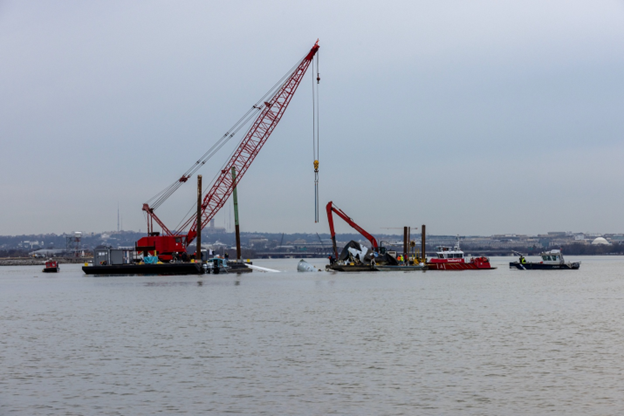
1 The NTSB, in coordination with the U.S. Navy Supervisor of Salvage,
recovering wreckage of the Bombardier CRJ700 on Feb. 3. [Online image].